

Welcome To Kyu Huwang
By the Year 2100, the Balance of Global Power Will Look Nothing Like Today
The New Face of the World Economy for Our Next Generation traces 197 countries, their economies, populations, and institutions, from the present to the end of the century. The numbers may surprise you.
Meet Kyu Hwang,
The Researcher Behind the Long View of the Global Economy
Kyu Hwang is an independent researcher whose work focuses on long-term global economic structures and the future distribution of world output. For this book, he assembled a dataset spanning 197 countries, including GDP and population projections through 2100, a scope not previously attempted in a single volume.
His argument is empirical: by the mid-2050s, when US global engagement contracted and the economic weight of the Global South had already surpassed that of the West, a genuine multipolar world was already in place. What 2100 looks like under current trajectories follows from the data.
Our Book
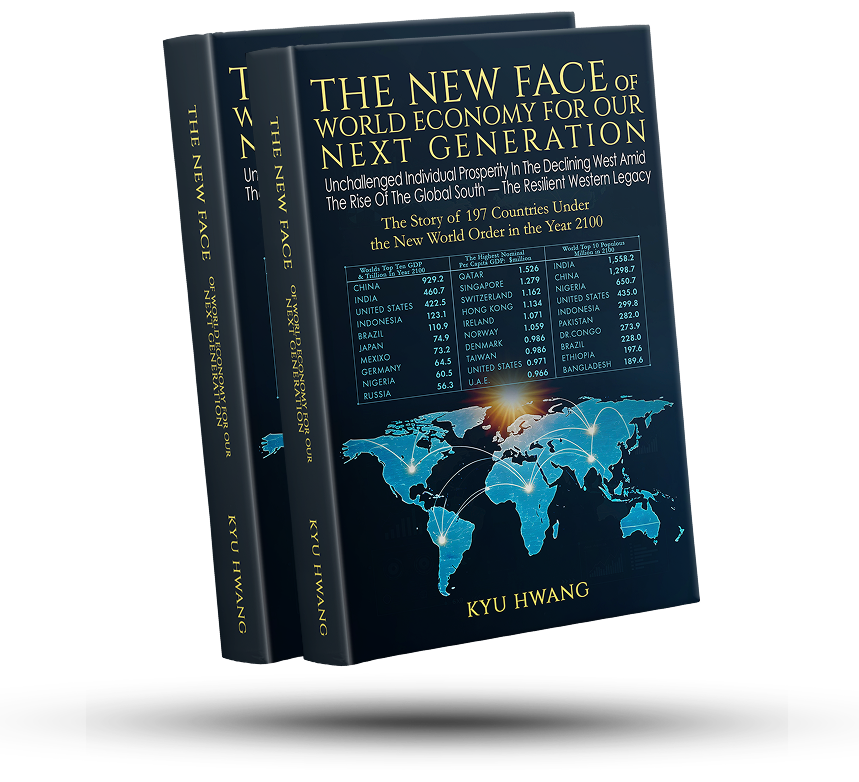
The New Face of the World Economy for Our Next Generation
By 2100, the GDP share of Western civilisation will account for only 23.7% of the global economy. Even more striking is the population share, just 10.6%. This book maps how that transformation unfolds, country by country, over the coming eight decades.
China leads the world GDP ranking in 2100 at $929.2 trillion, followed by India at $460.7 trillion. The United States ranks third at $422.5 trillion, a commanding economy but no longer the world’s largest. Nigeria, which barely registered on global GDP rankings at the century’s opening, reaches $60.5 trillion.
What You’ll Find Inside
- The demographic math that shifts global GDP by 2100 across 197 nations
- The reason fast growth in sub-Saharan Africa often fails to lift per capita income
- The structural limits behind Japan’s fall from second in 1968 to sixth in 2100
- The role of artificial general intelligence in countering ageing economies
- The complete dataset and the assumptions behind every projection
$16.99
$10.99
What Readers Are Saying
From economists, researchers, policy analysts, and general readers who came to the book for the data and stayed for the argument.
We advise clients on long-horizon market entry across Southeast Asia and West Africa, and we need a rigorous reference for structural economic assessment. This book does that job better than anything else currently available. The Indonesia analysis tracing its trajectory from $165 billion in 2000 to $123.1 trillion in 2100 is alone worth the cost. The data tables in Part II are formatted clearly enough to use directly in internal research documents.

Marcus Delacroix —
The Preface is the best single account I have read of how the geopolitical and economic landscape has shifted since 2020. The tariff wars, the COVID disruption, and the US–China rivalry, which are dragging most countries into strategic fog, are directly connected to the structural question the book seeks to answer: which economies have the demographic and institutional depth to navigate this environment and grow through it? The data chapters answer that question. The Preface tells you why it matters.

Elena Vasilieva — Writer, International Affairs
The book is admirably rigorous about what rapid African growth does and does not mean for African living standards. The point about Niger where an eleven-fold population increase wiped out per capita GDP gains for several decades should be required reading for anyone who cites Africa’s aggregate growth figures without qualification. The structural tension between GDP growth rates and population growth rates in sub-Saharan Africa is handled more honestly here than in most development literature.

Dr. Kwame Asante —
The book is admirably rigorous about what rapid African growth does and does not mean for African living standards. The point about Niger where an eleven-fold population increase wiped out per capita GDP gains for several decades should be required reading for anyone who cites Africa’s aggregate growth figures without qualification. The structural tension between GDP growth rates and population growth rates in sub-Saharan Africa is handled more honestly here than in most development literature.

Dr. Kwame Asante —
Notes on the Research
Supplementary observations, data updates, methodological notes, and reflections on the long-run economic trends examined in the book. Posts are published as new data become available or as developments warrant a closer examination of a specific country or projection.